If you work in the green industry cutting lawns and maintaining customer properties, a trimmer is an essential tool. There are some places that a mower just can’t go. Trimmers make it possible to neatly finish cutting the lawn by cleaning up along walkways, garden beds, and hard-to-reach spots. Trimmers are also useful for cutting grass and weeds in places that are challenging to mow, such as slopes or rocky terrain.
There are several options to choose between when shopping for trimmers. One of the big choices is between a straight-shaft or a curved shaft model. The power source is another key choice, with gasoline engines or battery-powered motors as the main options. The different options have pros and cons, but which ones are better for commercial use?
Trimmer Shaft Options
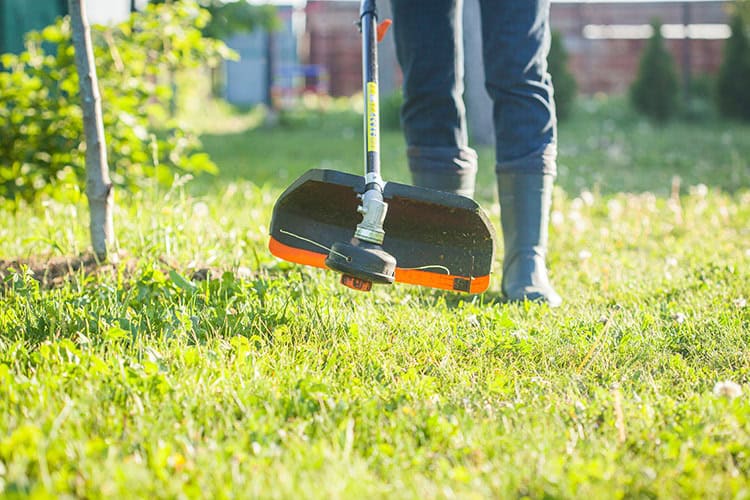
The types of trimmers that we’re discussing today are hand-held lawn equipment (we’re ignoring the walk-behind trimmers). They consist of a gasoline engine or electric motor at one end with a straight or curved shaft connecting the power source to a cutting head.
Straight-Shaft Trimmers
Straight-shaft trimmers are the preferred choice for most commercial applications. They tend to be powerful and durable enough to handle the demands of daily use.
Pros:
- Improved reach, such as for trimming under benches.
- Better durability for frequent use.
- Good for taller users.
- Generally more powerful, and can use brushcutter blades.
Cons:
- Heavier and harder to handle.
- May be challenging for shorter users.
Curved Shaft Trimmers
Curved shaft trimmers are typically recommended for homeowner use, though there can be situations where they’d be applicable for commercial users.
Pros:
- Improved maneuverability, making them useful for trimming in tight areas.
- Lighter and easier to handle.
- Good for shorter users.
Cons:
- Typically don’t hold up as well under heavy, frequent use.
- May be challenging for taller users.
- Generally less powerful and most can’t use brushcutter blades.
Handle Options
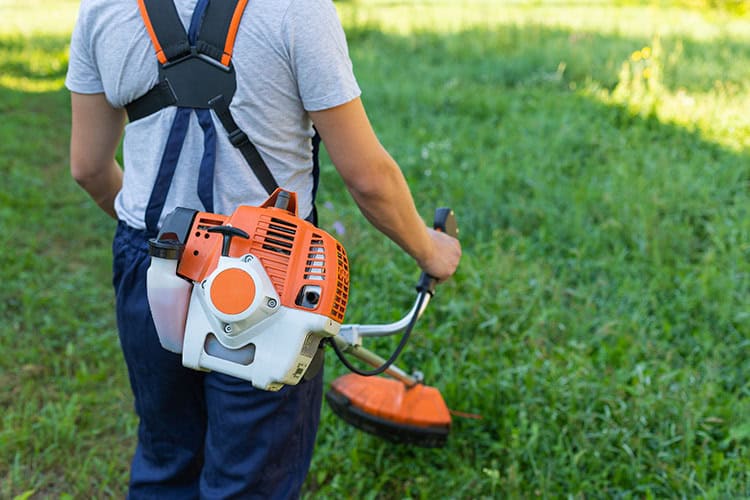
Handheld trimmers either have a loop handle or bicycle-style handlebars for the operator to use. Both can be paired with a shoulder strap or back harness to help shift the weight of the trimmer from the hands to the shoulders, making it easier to trim without getting tired.
Loop handles
Pros:
- More versatile and easier to maneuver.
- Give you more control when trimming in tight spaces or around flower beds.
Cons:
- May be tiring to use long-term.
Bike handles
Pros:
- Easier to use for long periods of time.
- Good for clearing large areas with a back-and-forth sweeping motion.
Cons:
- Less maneuverable in tight spaces
Power Source Options
The power source is a key choice you need to make when shopping for a commercial trimmer. While there are corded electric trimmers available, they’re not practical for commercial applications. The two main options are gasoline power and lithium-ion battery power.
Gasoline Power
For years, gasoline power has been the go-to option for commercial trimmers and they’re still a solid option for commercial applications.
Pros:
- Powerful cutting performance.
- Easy to refuel on the go.
- Lower initial cost.
Cons:
- Higher long-term costs due to fuel prices.
- Produce engine emissions.
- May be banned in some communities that don’t allow gasoline-powered equipment.
- Requires more maintenance to keep the engine running.
Battery Power
Modern battery-powered trimmers can be just as powerful as comparable gasoline models. More and more commercial lawn care companies are using a mix of gasoline and battery-powered equipment or switching over entirely to battery power for their handheld tools.
Pros:
- Low maintenance requirements because there’s no engine.
- Quiet operating noise.
- No engine emissions.
- Allowed in communities that ban small gasoline engines.
- Save money long-term by not purchasing gasoline.
Cons:
- Higher initial cost.
- May be challenging to recharge batteries while working.
Cutting Head Options
Trimmer cutting heads typically use either a string line or a metal blade for cutting. (There are also some models with small plastic cutting blades, which work similarly to string line trimmers.) Some models let you switch between string and blades, which makes the trimmer more versatile and gives you the best of both worlds. Green industry professionals will likely find use for both string line and bladed trimmers.
String line
Pros:
- Good for trimming around trees, edging, and other objects that would be damaged by a cutting blade.
- Effective at trimming around rocks, which might damage a metal blade.
- Lighter and easier to use for general-purpose grass trimming.
Cons:
- String wears down quickly and must be replaced fairly frequently.
- Can’t handle thick, brushy weeds.
Brush blade
Pros:
- Good for trimming dense weeds and heavy brush.
- Typically sturdy and long-lasting.
- Multiple cutting blade types are available to match a variety of needs.
Cons:
- May damage tree bark and other objects if you’re cutting too close.
- More expensive than string line to replace if the blade is damaged.
- More dangerous than string line; wear protective gear including sturdy work boots and long pants when using.
Multi-tool or Dedicated Tool
When shopping for trimmers, you can either get dedicated, stand-alone grass trimmers or brushcutters, or you can opt for trimmer heads as part of a multi-tool system.
Dedicated Trimmer
Pros:
- Multiple people can use different tools at once (e.g. three people using a stand-alone trimmer, a hedge trimmer, and an edger compared to one person using a multi-tool and swapping out different heads).
- The most powerful professional trimmers and brushcutters provide more cutting power than multi-tools can.
Cons:
- Multiple tools take up more space on trailers and in storage than a multitool system.
- May be more expensive than multitool systems, depending on how many individual tools you purchase.
Multi-tool
Pros:
- Only one power source to maintain for multiple tools.
- May be less expensive than purchasing stand-alone tools.
- Take up less room on equipment trailers or in storage.
- Can get curved-shaft and straight-shaft trimmer heads to easily switch between the two.
Cons:
- Only one person can use the tool’s powerhead at a time, possibly slowing down work.
- May be less powerful than other commercial trimmers and brushcutters.
Commercial Trimmer Brands
The type of shaft, handle options, power source, and cutting heads are four of the biggest choices that you’ll have to make when you’re selecting trimmers for commercial use. You can also choose between dedicated trimmers or a multi-tool system, or keep a few dedicated trimmers in your equipment fleet and use a multi-tool as a backup.
You’ll also want to consider operator comfort, including ergonomics and ease-of-use features, and the quality of the trimmer. Trimmers designed for commercial use typically include ergonomic features to reduce strain on the operator since they’re built with green industry professionals in mind. Here at Richardson Saw, we carry top-quality trimmers from STIHL, Echo, EGO, RedMax, and Toro that are perfect fits for professional use. Give us a call, browse our website, or stop in at our Richardson, TX, location to see your different commercial trimmer options.